
Culture & First Nations
The Teslin Tlingit Heritage Centre: Clans, Canoes & Carving
6 min read
The Teslin Tlingit Heritage Centre: Clans, Canoes & Carving
The five clans
Teslin Tlingit society is organised into five clans — Kùkhhittàn, Ishkeetàn, Yanyèdi, Dēshitan, and Dakhl’awèdi — each represented by carved totem poles at the centre. Understanding the clan system is key to understanding Tlingit governance, kinship, and art, and the centre’s displays and guides explain it clearly.
Clan membership passes through the mother, and the clans are grouped into two halves — Raven and Wolf — that historically married across rather than within. That structure is not a historical footnote. It still shapes who speaks for what, who hosts and who is hosted at a potlatch, and whose crests may appear on which object. The poles outside are, in effect, a public statement of that order.
Art and carving
The centre houses hand-carved canoes, regalia, clan crests, and traditional artwork, and an active carving shed keeps the skills alive. Watching or learning about the carving of a canoe or a pole connects the art you see to the people making it today.
Formline is the visual language behind most of what you will see: ovoids, U-forms and continuous black outlines that resolve into ravens, wolves, frogs, beavers and killer whales once you know what to look for. It is a coastal system, which is itself a reminder of where the Inland Tlingit came from and how far up the trade routes from the Pacific this culture reached.
Visiting
Located right on the highway in Teslin, the centre makes a rewarding stop on a road trip between Whitehorse and Watson Lake or the BC border. Check seasonal hours (it’s busiest in summer), allow time for the exhibits and any performances, and approach the culture as a guest and learner.
Give it more time than a highway stop usually gets. An hour is a reasonable minimum for the exhibits and the poles, longer if there are performances, demonstrations, or someone in the carving shed willing to talk. Hours are seasonal and the centre is quiet or closed outside the summer months, so check before building a day around it.
Why it matters
Far from a static museum, the Teslin Tlingit Heritage Centre is a place where a distinct northern culture actively teaches and celebrates itself. Stopping here turns a drive along the Alaska Highway into a genuine encounter with the people whose home this has always been.
It is also, plainly, one of the better-told stories on this stretch of road. Much of the Alaska Highway’s interpretation is about the highway itself — its construction, its engineering, the men who built it. Teslin is where you get the other side: what was already here, what the road was driven through, and what the community made of the enormous change it brought.
The Inland Tlingit, and how they got here
The Tlingit are a coastal people, and the Teslin Tlingit are their inland branch. Their ancestors moved up the trade routes from the Pacific coast, through the mountain passes, trading with and marrying into the Athabascan peoples already living in the interior. The result is a culture that is recognisably Tlingit in clan structure, art and language, and thoroughly northern-interior in how it lives on the land.
That history explains much of what the centre shows. Coastal formline design a long way from any coast, canoes on a lake in the middle of the Yukon, a clan system operating in country where neighbouring nations organise themselves differently. The trade routes are the thread running through it, and the exhibits follow that thread rather than treating the culture as if it had always been static.
The poles, and how to read them
The five poles standing at the centre correspond to the five clans, and each carries the crests belonging to that clan rather than telling one continuous story. Poles are not read top to bottom like a page. They are statements of identity and right — this is who we are, and these are the crests we hold — and the carved figures are the vocabulary of that statement.
Standing in front of them with no explanation is fine, but ten minutes with an interpreter or the centre’s own material makes a large difference. That is the point at which the carving stops being decorative and starts being informative, which is more or less the whole argument for stopping in Teslin instead of driving past it.
Teslin itself
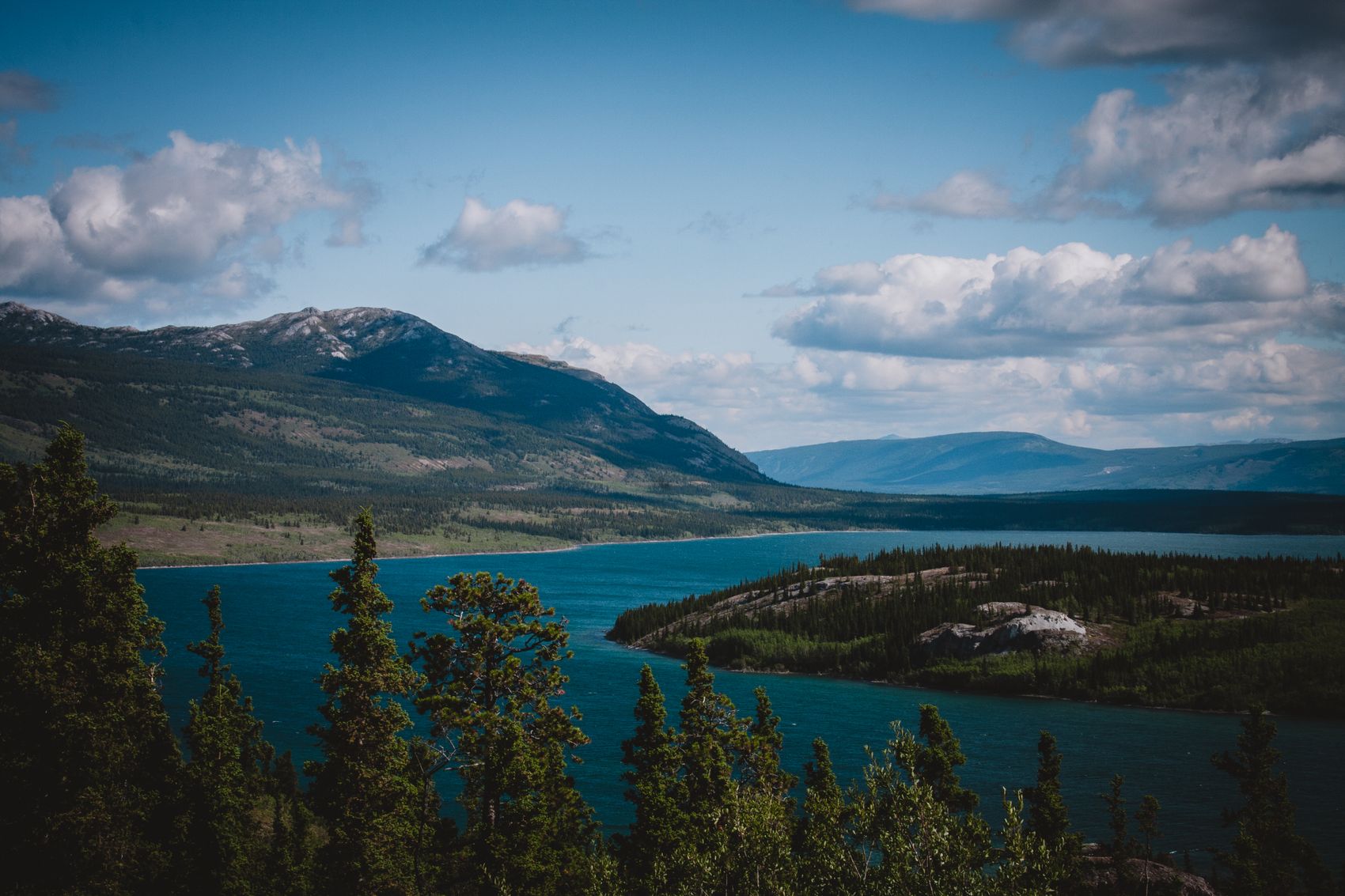
The community sits on the shore of Teslin Lake, one of the largest lakes in the territory, roughly halfway between Whitehorse and Watson Lake on the Alaska Highway. The long bridge over Nisutlin Bay is the landmark most drivers remember, and there is fuel, food and a small museum on the highway side of the community.
It works best as a deliberate stop rather than a rest break. Whitehorse to Teslin is comfortable in about two hours, which makes the heritage centre a plausible day trip on its own, and it breaks the long run southeast towards Watson Lake in a way a gas station cannot.
Going as a guest
The centre is run by the Teslin Tlingit Council, and the difference between a museum and a community institution is worth holding in mind. Ask before photographing people, regalia or ceremonies. Follow whatever direction is given about specific objects. If a dance or a song is performed, watch as an audience rather than as a camera operator.
None of that makes the place formal or forbidding — it is welcoming and thoroughly used to visitors. But the exhibits belong to living clans with members in the building, and behaving like a guest rather than a customer gets you a much richer visit. Questions asked respectfully are almost always answered generously.
Frequently asked questions
Where is the Teslin Tlingit Heritage Centre?
On the shore of Teslin Lake in the community of Teslin, right along the Alaska Highway southeast of Whitehorse.
What will I see there?
Totem poles representing the five Teslin Tlingit clans, hand-carved canoes, regalia, clan crests, an active carving shed, and art galleries.
When is it open?
It operates mainly in the summer season with seasonal hours; check ahead, especially outside the peak months.
How long does the drive from Whitehorse take?
About two hours southeast on the Alaska Highway, which makes the centre a workable day trip from Whitehorse or a natural stop on the way to Watson Lake.
Can I take photographs?
Of the poles and the building generally, yes. Ask before photographing people, regalia or any performance, and follow whatever direction staff give about specific objects.
Where to stay
Rooms worth pairing with this guide.

Ready to plan this trip?
Real prices for the places this piece names.


